 What is Cyclescape?
Cyclescape is a new facility to provide cycle campaign groups around the UK and their members with a toolkit for easy discussion and resolution of campaigning issues. It aims to make it easier for people to get involved, get up to speed on any issue facing cyclists, work more productively with Local Authorities, and discover best practices and case studies from around the UK. Geography is at the heart of the system.
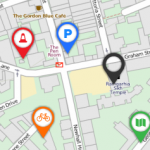
Example: reporting cycle parking problems – area selection screen:

What can we do on it?
We’re working to provide a ambitious platform that enables people to:
- Find out what’s going on in your area or where you cycle
- Get involved in as many or as few issues as you want
- Contribute to discussions easily without feeling overwhelmed
- Easily discover key resources and have best practice and guidance summarised
- Keep on top of deadlines, e.g. the date for a council consultation
- See planning applications appear automatically on the map – that could create new barriers or opportunities for cycling
- Analyse collision data
- See the history of any issue to avoid reinventing the wheel
- Work productively with others, including Local Authorities where wished, to create actual change on the ground
Who is it available to?
Cyclescape is available to any cycle campaign group in the country. One of our aims with it is to provide a platform that will also assist the creation in new groups around the country.
Local Authorities are also targetted, with a view to enabling campaign groups to work more effectively with LA officers. Local Authorities could find Cyclescape useful for obtaining consultation feedback.
Who has created it?
CycleStreets, who run the UK-wide cycle journey planner, CycleStreets. We come from a cycling advocacy background, being Committee members of one of the largest groups in the country (Cambridge Cycling Campaign). CycleStreets is a social enterprise set up as a not-for-profit limited company.
The initial programming work was done by Andy Allan and Andrew France as contractors working for CycleStreets, with Martin from CycleStreets managing the project, with further work by Nikolai Berkoff and other contributors such as Shaun McDonald. The design work has been done by Supercool of Birmingham.
What are the motivations behind the project?
Primarily, we want to enable people who care about conditions for cycling in the UK to be able to get involved in campaigning for improvements, at whatever level of involvement they want.
Crucially, also, we want to make cycle campaigning much more effective. At the moment there are lots of different voices sometimes acting in an uncoordinated way. If discussions can be made more solution-focussed, working with Local Authorities will become easier.
What are the main concepts in the system?
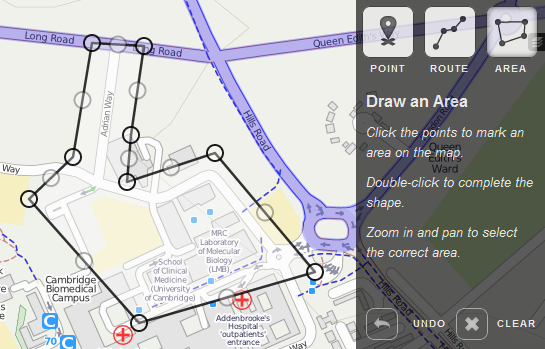
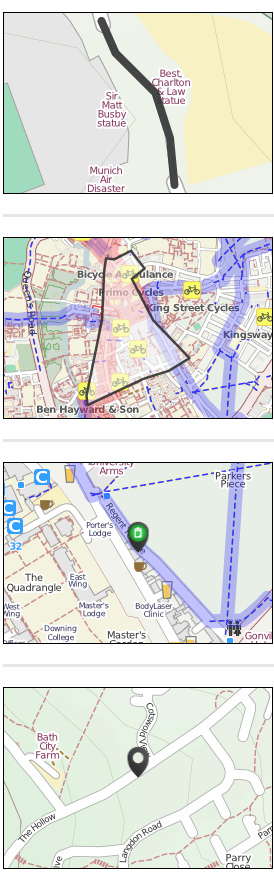
- Map – issues are located on a map. They can be a dot on the map (e.g. for lack of cycle parking), a line (e.g. a route) or a shape (e.g. the site of a proposed a new building)
- Issues – these are a location on the map where there is a problem or potential problem, including a brief description of the problem. For instance, lack of cycle parking, a poor junction, a new building that might sever a cycle route or provide the space for a new route. Basically something that campaigners need to campaign on!
- Threads – discussions connected to an issue. There might be more than one per issue. For instance, a major new office block might have discussions on the amount of cycle parking, on a new route that could be created, and another on how a northern access road needs a cycle lane added.
- Library – this is an area where best practice, case studies, and guidance can be added and summarised. The idea is that relevant items can be ‘dragged into’ a thread, so that newer campaigners are up-to-speed quickly.
- Privacy – discussions are specific to a group (unless you set otherwise) and can be private or publicly-viewable.
- Deadlines – threads can have deadlines attached so that important dates, like consultation deadlines, meetings, events are prepared in time.
- Tags – these are simply keywords (e.g. ‘cycleparking’, ‘obstruction’) added to issues/threads/library items. This helps match things up easily. For instance, discussion of an issue with the ‘cycleparking’ tag would flag up guidance on cycle parking standards and design.
- My Cyclescape – gives an overview of activity relevant to you
- Planning applications tab – shows planning applications in your area, which you can easily clone to become an issue like any other
- E-mail (optional) – you can choose to get e-mails for each reply or as a daily digest – just like an e-mail list (except you can easily unsubscribe from topics you don't want to hear any more about)
- General chat area – (forthcoming) useful when things aren’t really issue-based
Show me some features!
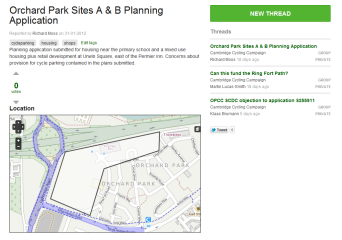
Discuss things in an organised and archived manner, with a clear map location:
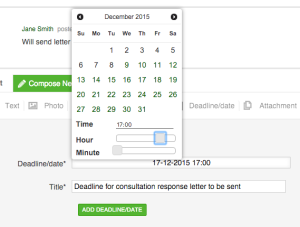
Dates and deadlines – avoid missing Council consultations:
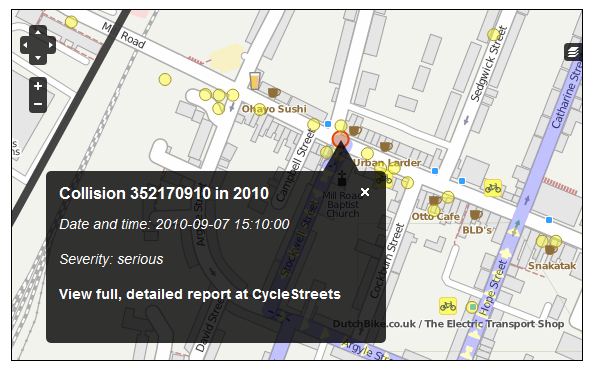
Integrated collision data: view problem junctions and back up analysis with actual data:
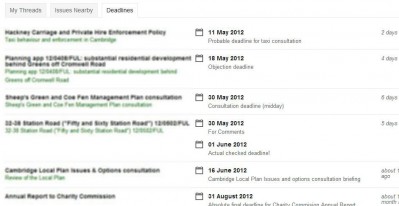
My Cyclescape: an overview of what's going on:
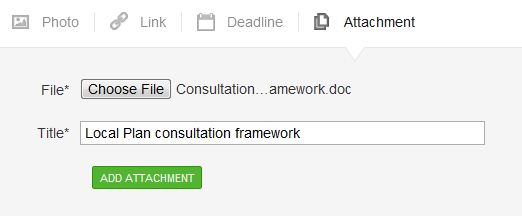
Add attachments, photos, links:
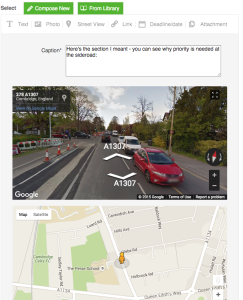
Add a Street View location:
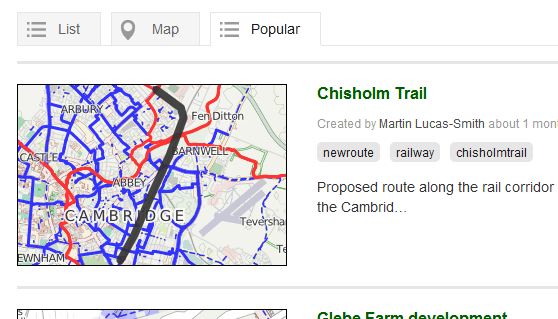
View and rate popular issues:
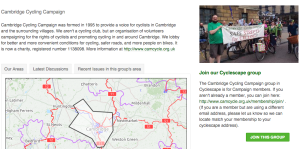
Group-specific areas:
Where can I sign up my group?
Just go to the groups area and request to create a new group. It's free.
How did you win the initial funding?
GeoVation, provided funding of £27,000 in a dragon’s den –style competition in which CycleStreets pitched the concept amongst 155 other ideas. We were one of the seven winners. GeoVation is an Ordnance Survey initiative and forms part of the Ideas in Transit project with funding from the Technology Strategy Board and the Department for Transport.
CycleStreets has also put in funding subsidised from commercial journey planner work recently undertaken, as well as grants from CTC, Lush Charity Pot, the Polden-Puckham Charitable Foundation, and (for one area only) Cambridge Sustainable City and Cambridge Cycling Campaign.
What funding is needed?
We are seeking funds for a full-time developer. We have an enormous number of ideas and proposed improvements on how to integrate campaigners, issues, Local Authorities, and cycling data together in clever and time-saving ways.
How does this compare to our group's current mailing list?
Cyclescape is much more than just an inflexible mailing list (though you can use as a mailing list too – even digests are supported).
Firstly and most importantly, it recognises the key point that cycle campaigning happens in a geographical context. So with Cyclescape you can see where issues are, subscribe to things in areas of interest to you, and see how nearby things relate.
With an e-mail list, everyone gets everything and there is often an implied level of knowledge. With Cyclescape, you can dip into as much as you want, monitor what’s going on, and get up to speed on issues easily, creating a useful archive as you go.
Any user who prefers to use e-mail rather than a website for discussions, can easily enable the e-mail facilities in Cyclescape. This basically turns each thread that you subscribe to into an automatic mini e-mail list that you can reply to in the normal way. And of course you can unsubscribe from a thread at any time. Users can also opt to receive e-mails as a daily digest.
Is it free for groups to use?
Yes, though donations towards project costs are extremely welcome. If you know of any grant sources, we'd love to hear from you also.
Could it be used by Local Authorities for consultation purposes?
Potentially, yes – just add issues to the map, and encourage people to sign up. However, do bear in mind that responses will be public, or if you create a private thread, will be visible to other people commenting. Cyclescape was designed for group discussion, rather than anonymous and private posting.
We're very open to adding new features that Local Authorities and others would find useful. Do get in touch if you have any suggestions.
What about privacy and security?
Groups have their own area of the site, with their own address like groupname.cyclescape.org.
Groups can set discussions to be public or private by default. Individual discussions can be set to be different to this default if people wish. Committee members set all the defaults for the group.
Users can set a variety of privacy preferences.
The code is written from a secure-by-default perspective. There is a central section of the code where the different privileges afforded to different group of people are defined.
What about backups and resilience?
Discussions and attachments (i.e. the database and binary files) are backed up daily. These backups go to a second machine in a different datacentre.
The second machine is able to run the system, so we have a fallback system that will be at most one day out-of-date. We will set the backup regime to be even more regular as soon as possible.
I’m a programmer – can I get involved?
Yes, if you know Ruby on Rails or can pick it up. The code is open source and uses open data.
Rails is a very robust platform for web applications that provides a framework based on MVC and features excellent support for tests. The code is on GitHub and we have included documentation to get you going. There is also a deployment repository for scripted deployment.
Read more on how to get involved in the coding.
Don’t hesitate to drop us a line if you’d like any help – we’re keen to get people involved.
I have another question…
Drop us a line and we’ll answer it and add it here.
Do also browse through our blog: https://blog.cyclescape.org/ for more details.
Pingback: CycleStreets » Blog
Pingback: CycleStreets » Blog
Pingback: UK Collision Map – a new resource for the cycle campaigning community | Open Data Aha!
I run a cycling campaign group website but don't have many web skills. Is it possible to have Cyclescape as a Widget so that visitors to our website can view Cyclescape consultations & discussions without leaving our site?
Thank you